It’s pumpkin pollination time! It’s time for a little romance out in the pumpkin patch. Dearly beloved, we are gathered here together to unite this man and this woman….. In this article on how to pollinate pumpkin plants, you will be able to identify male and female flowers. You will learn how to assure the proper pollination. And, when nature fails, you will learn about hand pollination of pumpkin flowers.
Birds do it. Bees do it. And, nowadays pumpkin growers do it out in the pumpkin patch. That is, we pollinate pumpkins when necessary. In case you did not know, the nation’s honeybees were devastated by a major parasitic disease, along with overuse of pesticides. Farmers have always relied on Mother Nature’s Honeybees to do the pollination task. Now, humans often play a supporting role.
The number one question asked each year is about pumpkin pollination problems.
If your situation fits any of the following situations, you should plan on taking steps to assure proper pollination:
Assuming all has gone well, sometime in July, your pumpkin plant will begin to produce flowers. First to arrive are the male flowers. They usually appear in large numbers, a week or two before the first female comes upon the scene. New growers often worry that there is something wrong with the plant, as no females have appeared. This worry is heightened when talking with experienced growers who will be a week or two ahead of novice growers and boast of pumpkins already growing on the vine. Never fear, your pumpkin plant will eventually develop female flowers with tiny fruit attached below the flower.
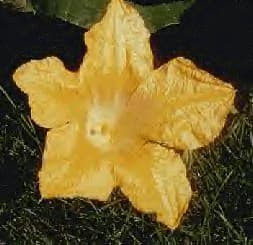
Male Flowers (above) are on an erect stem that is fairly thin and shoots up several inches above the vine. The center stamen contains the pollen. Do not pick and use it until the pollen is mature. Pollen is mature if it readily comes off the stamen and onto your finger. There are usually several male flowers for every female flower. There should be a mature male or two ready to pollinate whenever a female matures.
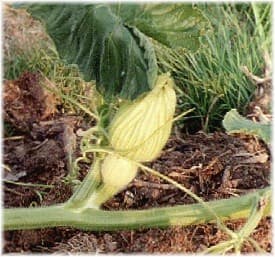
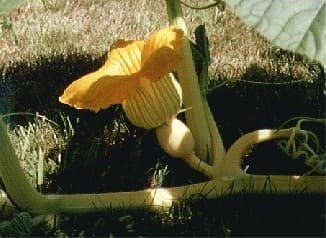
Female flowers (above) are easily identified. A tiny baby pumpkin fruit is located between the stem and the flower. The female flower is close to the vine. And, the stem is short, just an inch or so in length. In the center of the pumpkin flower is a multi-segmented stigma. This stigma must be pollinated in order for the fruit to develop. The first picture (above) is an immature female (closed flower). The second picture above, shows a mature female with her flower open and ready to be pollinated.
This is the million-dollar question. The affirmative answer is discovered after several days, when the female flower has died and fallen off, and the tiny pumpkin beneath it begins to grow. This is also called “Fruit Set”.
If pollination did not occur, the baby pumpkin below the female flower shrivels and dies.
Poor pollination can also occur. Pollination needs to be made to all segments of the female flower. If not, the fruit will not reach its maximum potential, and the fruit produces fewer seeds. It may even abort, too.
Pumpkin Pollination Prayer: God, please give me patience, and give it to me now!
While the honeybee population is down, many other insects are pollinators. One of the pumpkin growers’ most feared enemy, the cucumber beetle, is also a pollinator. Any insect that is attracted to the pumpkin flower is a potential pollinator. It must travel in the right sequence, from male flower to female flower.
If pesticides are used, you are killing off the pollinators in your area.
If you rely on Mother Nature, you will not know the results for several days after the female blooms. For those growing giant pumpkins, every day counts. You do not want to risk failure of the first few fruit or poor pollination, which is often not evident until the fruit has been growing for a while.
To learn more about pollination, check out The Pollination Scene While this site does not speak to pollinating pumpkins in particular, the content on the site is very thorough. And, it provides a wealth of links to other sites on pollination.
Jokes about hand pollination abound, both on the internet and in the field. Does anyone object to helping their plant to have sex? Okay, with that said, on to the learning….
By pollinating your pumpkin flowers by hand, you assure a number of things. First, you use pollen from a male pumpkin from a plant you select, versus Mother Nature’s random selection of pollen from male flowers in the area. Hand pollination eliminates breeding a giant pumpkin with a nearby Zucchini Squash. Second, it significantly increases the likelihood of successful pollination of the female flower, although nothing is an ironclad guarantee. Third, it increases the likelihood of pollinating all segments of the female flower.
Tip: To increase the likelihood of hand pollination by the desired pollen, put a nylon stocking, a fine screen, or other cover over the female flower the night before pollination. After hand pollination, re-cover the flower. Be careful not to damage the flower, especially the stigma.
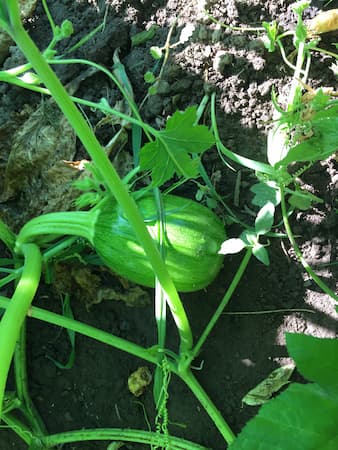
Cross pollination from one plant of the same variety to another is good and healthy for a species. It is nature’s way of ensuring the survival of the species over time. Cross pollination of one variety to another variety in the same family can be good if you are experimenting with, or attempting to create new varieties or disease-resistant strains. Or, it can be bad, if you are trying to grow a pumpkin, and a cross with a Zucchini occurs.
In the first instance, cross pollination in nature exists to broaden and stregnthen the gene pool of a particular species, be it animal (including humans) or plants. The broader the gene pool, the more likely a subset of the population will survive some future disease or bacteria. Botanists use cross-pollination to seek and maximize a certain desired genes’ occurrence in the population. This includes disease resistance, size, taste, nutritional value, etc. The resulting hybrids are then made broadly available in agriculture. While enhancing certain traits of the species, cross pollination in the latter case is narrowing the gene pool and thus increasing the risk to long-term survival. As a side note, the popularity of “Heirloom” seeds draws upon a variety of almost forgotten or lost strains of a species. See Heirloom seeds
Cross-pollination, of giant pumpkins appears to cause risk to long-term survival. Often, pollen from the male of the same plant is used to pollinate the female flower. Secondly, growers are pollinating the largest of the species, forsaking all other attributes of the plant. In our search for genetic size, for example, we are overlooking disease resistance. While this may appear to bear some risk to long-term survival, there is enough of a gene pool world-wide and enough strains of this species to allay any concerns.
Cross-pollination across varieties of the same species is undesirable when a pumpkin crosses with a squash of the same variety. Invariably, at least one (if not several) growers will ask me why their pumpkin is growing long like a zucchini. This is very common if you have both plants in your garden. It is also possible for your neighbors’ Zucchini pollen to get to the female pumpkin flower first, before the pollen from one of your pumpkins arrives either by nature or with your help. The only way to avoid this problem is to make sure there are no cross-pollinators growing in the vicinity of your garden, a difficult task for home gardeners who want variety. As a result, you will likely live with an occasional half breed.
Using seed from your garden is common among growers. If you suspect cross pollination of your plants, you should buy fresh seed. Even if the fruit of your vine grows true, it may pass the cross-genes in the seed to the next generation. If two or more of your fruit prove to be a cross, pull up and discard the plant(unless by chance, you like the result).
Fruit Set refers to the overall process of pollination and early growth of a pumpkin fruit. Proper fruit set has occurred after pollination as described above. But other factors affect the proper setting of fruit. The emergence of male and female flowers is an important part of this process. Your fertilization program can impact this. Early in your plants’ life, use a fertilizer high in Nitrogen to promote leaf, vine, and root growth. But too much nitrogen for too long a period may cause your plant to delay the flowering process. If this seems to be the case, first check with other growers in your area to see if their plants have begun to flower. Once you decide your flowers are late, stop using fertilizer with nitrogen on your plant for a week or two. Instead, add more phosphorous.
We have talked about poor pollination affecting fruit set. We have also identified too much nitrogen as a factor which results in the delay of the setting of fruit on the vine. A few other factors can affect fruit set. The most common is a mid-summer heat wave. High day and nighttime temperatures will cause plant stress. The tiny pollinated fruit may abort as a result. A heat wave can also deter bees from their job, making hand pollination more important. If your fruit is shriveling and dying and you are in the middle of a heat wave, don’t worry or panic. As soon as the weather cools, you will see new females appear, and successful pollination should occur.
While you can not completely cross out plant disease as a cause of poor fruit set, it is far less likely. If your plant is visibly healthy, is growing well, and you can find no evidence of disease, this is most likely not the cause of poor fruit set. If you identify a disease problem, vigorously attack the problem. Once conquered, you should find successful pollination and growth even though it will be later in the season.
Also see: FAQS: Pumpkin Pollination Problems